Philodiagram
# Philosophy Atlas
## Short description
An interactive, bilingual map of Western philosophy that connects 105 thinkers across 2,650 years of ideas, questions, influence, criticism, and transformation.
## About
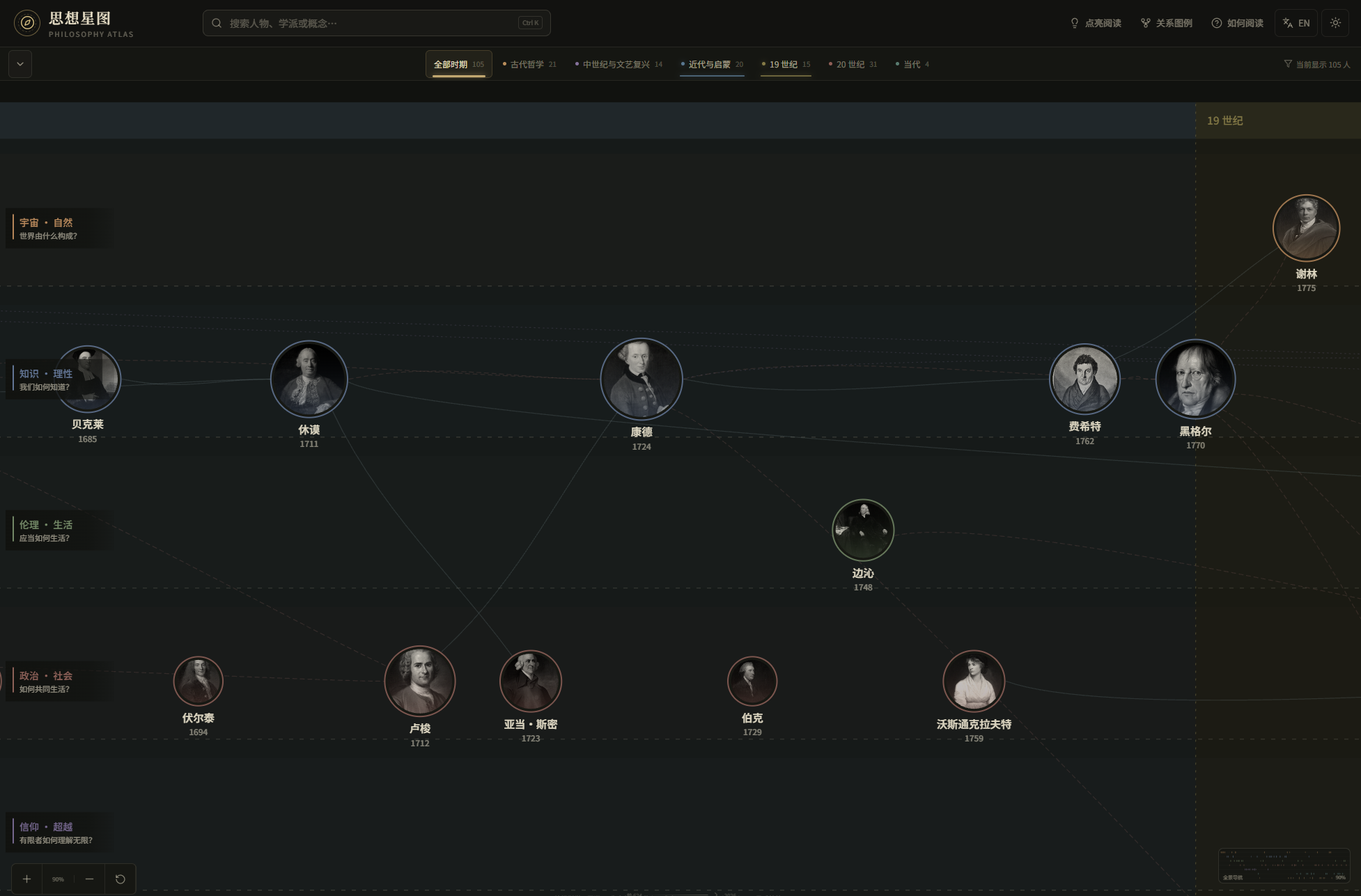
**Philosophy Atlas** is a navigable history of Western philosophy. Rather than presenting philosophy as a list of isolated names and dates, it places thinkers on a shared canvas where time, questions, and intellectual relationships can be explored together.
The atlas currently includes **105 philosophers**, from Thales to Judith Butler, connected by **103 editorially selected relationships**. These links represent mentorship, influence, critical inheritance, and the transformation or synthesis of earlier traditions.
Thinkers are arranged from left to right by birth year and placed across seven question-based lanes:
- Cosmos and nature — What is the world made of?
- Knowledge and reason — How can we know?
- Ethics and life — How should we live?
- Politics and society — How should we live together?
- Faith and transcendence — How can the finite understand the infinite?
- Language and science — How do meaning and evidence work?
- Existence and critique — How do we become ourselves?
The result is not a definitive ranking or a complete history. It is an editorial learning map designed to make philosophical inheritance visible and to invite further reading.
## Two ways to explore
### Free exploration
Move freely across the timeline, search for a thinker, school, or concept, filter the canvas by historical period or central question, and open any portrait to read a concise introduction, key ideas, selected works, sources of influence, and later connections.
### Light-up Reading
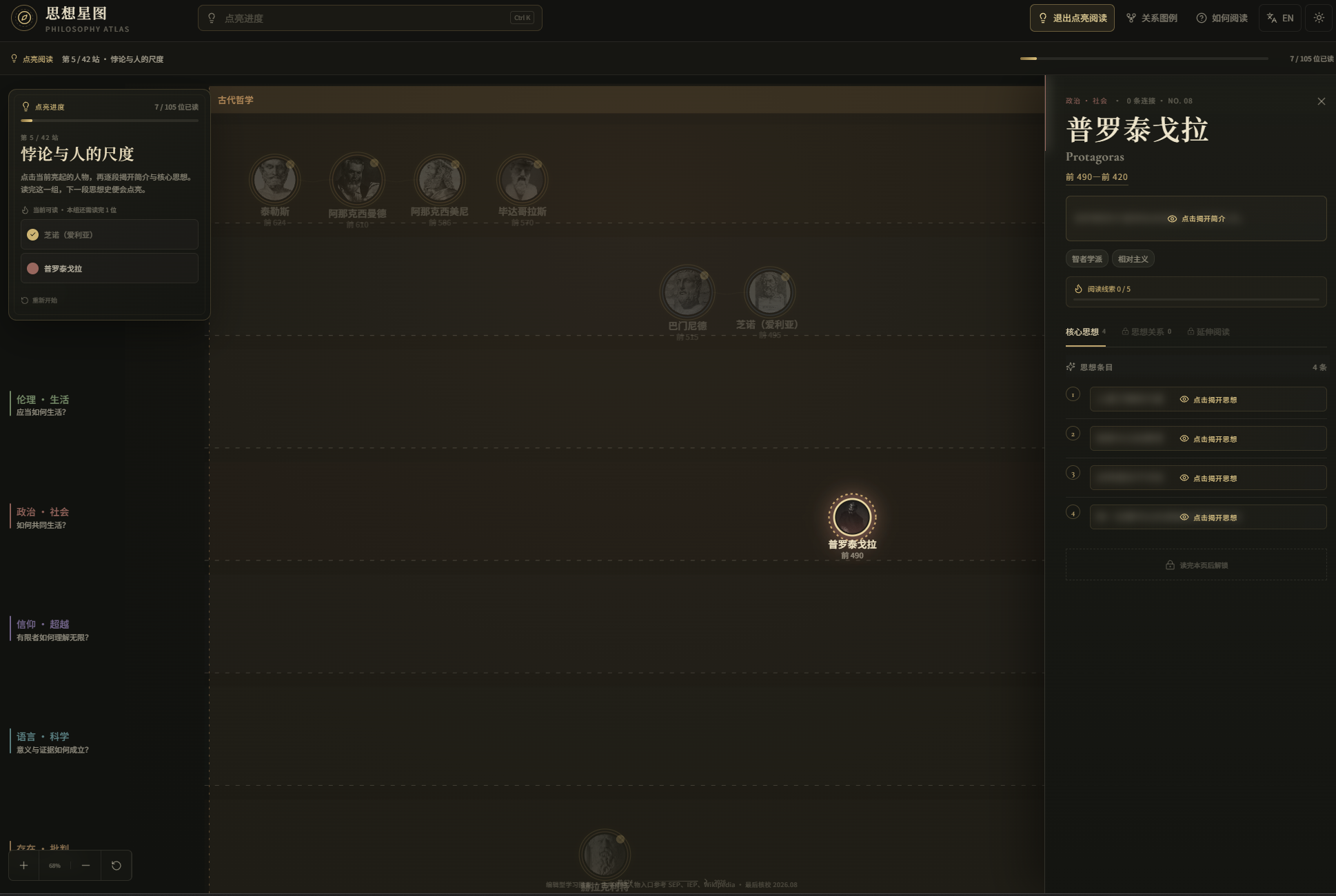
If you are unsure where to begin, enter **Light-up Reading**. This guided journey starts with Thales and gradually illuminates the atlas through **42 stages**. Read the currently available thinkers, reveal their introductions and ideas, and unlock the next chapter of the philosophical story.
Reading progress is stored locally in your browser. No account is required.
## Features
- 105 thinkers spanning approximately 2,650 years
- 103 intellectual relationships
- Seven question-based philosophical lanes
- A 42-stage guided reading journey
- Search across people, schools, concepts, and ideas
- Historical-period and question filters
- Thinker profiles with summaries, ideas, works, and further-reading links
- Chinese and English interface languages
- Light and dark display themes
- Responsive desktop and mobile layouts
- Local reading-progress storage
## Controls
### Desktop
- Drag the canvas to travel through time
- Use the mouse wheel to zoom
- Click a portrait to open a thinker profile
- Use the search bar or filters to narrow the atlas
### Mobile
- Drag with one finger to move across the canvas
- Pinch with two fingers to zoom
- Tap a portrait to open its profile
- For the best experience on itch.io, launch the atlas in fullscreen mode
## Languages and themes
The interface is available in **Chinese and English** and can be switched at any time. The atlas also includes light and dark themes. On the first visit, language and appearance follow the browser and system preferences when possible.
## Network use and privacy
The core atlas and its interactions run directly in the browser. Preferences and Light-up Reading progress remain in local browser storage and are not uploaded.
Portraits are requested from the Wikipedia API when available. If a portrait cannot be loaded, the atlas falls back to the thinker's initials. External further-reading links and portraits require an internet connection.
## Editorial note
Philosophical influence is often indirect, disputed, and multidirectional. The relationships and primary-question lanes in this atlas are editorial learning guides, not claims of complete scholarly consensus. The summaries are intended as starting points and do not replace primary texts or specialist research.
Biographical information and further-reading routes are checked primarily against:
- [Stanford Encyclopedia of Philosophy](https://plato.stanford.edu/)
- [Internet Encyclopedia of Philosophy](https://iep.utm.edu/)
- [Wikipedia](https://www.wikipedia.org/)
The visual organization also draws inspiration from Deniz Cem Önduygu's [History of Philosophy](https://www.denizcemonduygu.com/philo/browse/). All entries in Philosophy Atlas have been independently summarized and organized for this project.
## Accessibility note
Philosophy Atlas is a visually dense, canvas-based learning experience. Keyboard-accessible interface controls, text profiles, scalable views, high-contrast themes, and responsive layouts are provided, but navigating the full relationship canvas may be easier with a pointer or touchscreen.
Comments
Log in with itch.io to leave a comment.
What a great game! I really love the aesthetic. I gave it a rating!
I released my own horror game, MILE 27, today: https://nincy12.itch.io/mile-27
If you can spare a few minutes to check out the game, I’d love to hear your feedback and see your rating! Thanks!